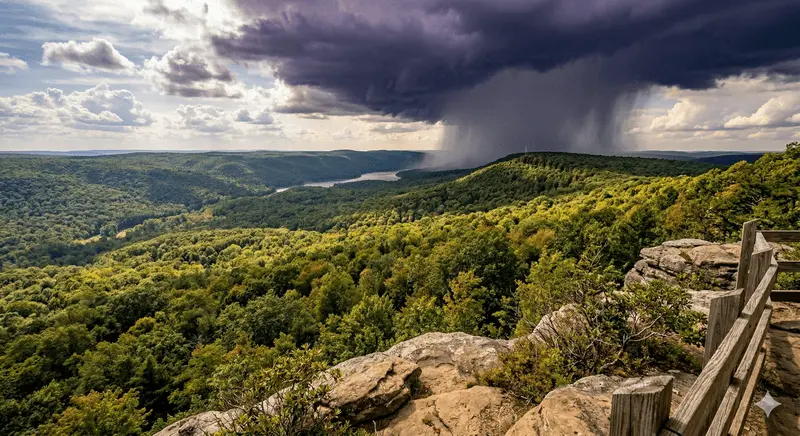
The weather on the Allegheny High Plateau does not follow the rules of Pennsylvania. Ask any seasoned local, and they will tell you that a sunny forecast in Erie or Pittsburgh can mean a localized torrent over the Kinzua Dam. This isn't just folk wisdom; the geography of the Plateau—a massive, ancient lift rising abruptly from the surrounding lowlands—creates its own fierce, localized microclimate.
Here, the "Lake Effect" is a dominant and unpredictable force. As cold Canadian air sweeps across the warmer waters of Lake Erie, it picks up moisture and heat. When this destabilized airmass hits the western escarpment of the Plateau, it is forced upward. This process, called orographic lift, causes the moisture to rapidly condense, dumping feet of snow in the north and unpredictable squalls across the central Plateau.
The Rains: Why the Plateau Dries Fast
This same lift mechanism creates unique precipitation patterns in the warmer months. Rain systems moving from the Ohio Valley are compressed as they climb the 2,000-foot slopes. The result is often intense, localized cells—the legendary "Allegheny Rains"—that can hammer one watershed while leaving the next dry.
This intensity, however, is countered by the region's geography. The Plateau is not smooth; it is carved by thousands of deep, V-shaped valleys and runoffs. As we noted in our Jakes Rocks guide, the region's soil is grit-heavy, lacking the clay found just 50 miles south. This geological quirk means that while the rains may be heavy, the steep slopes and excellent drainage ensure that trails and forest roads often dry hours faster than surrounding areas.
The Microclimate Effect: Valley Fog and Ridgetop Gales
The dramatic elevation change between the deep river valleys (like the Allegheny) and the ridgetops creates multiple sub-microclimates.
On autumn mornings, the cold, dense air sinks into the valleys, trapping moisture and creating thick, dramatic "sea of fog" effects over the Kinzua Reservoir. While a paddler on the river may be navigating a visibility of less than 10 feet, a hiker on the rim trails (like Rimrock) can look down onto a blinding white cloud, completely bathed in sunlight. By contrast, the exposed ridgetops are battered by gales that seem to appear from nowhere, funneling through the gaps in the plateau.
Snow: The Lake-Effect Machine
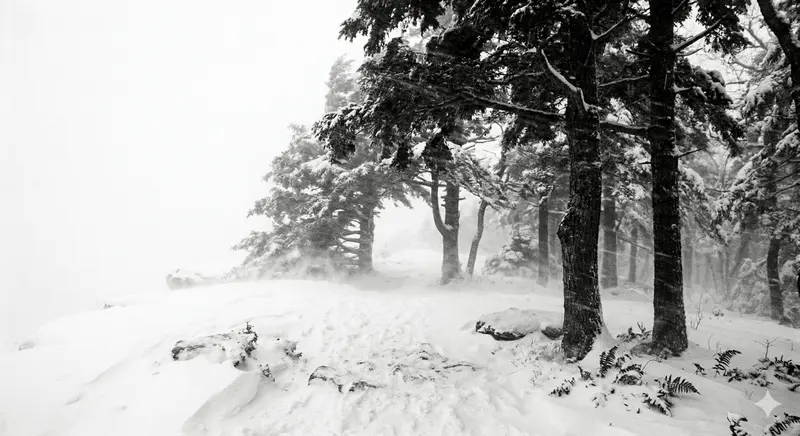
Winter is when the Plateau truly defines itself. While southern Pennsylvania may see a dusting, the northern tier, including Warren and McKean counties, consistently experiences some of the highest snowfall totals in the eastern United States. This is the heart of the "Lake-Effect Machine."
When the conditions are right—a strong west-northwest wind and an unfrozen Lake Erie—the Plateau can be buried. These storms are characterized by their intensity and localized nature; you can drive five miles from a clear sky into a complete whiteout. This dependable snowpack, however, is what fuels the massive snowmobile trail system that snakes across the forest, turning the wilderness into a winter playground.
A Climate of Resilience
Understanding the microclimate of the Kinzua region is essential for any outdoor enthusiast. The weather here is not random; it is a direct reflection of the ancient, powerful landscape. Respecting its sudden squalls, rapid temperature swings, and intense snows is part of the "High Plateau" identity. The resilient forests of the Allegheny—the hemlocks, the oaks, and the sycamores we paddled past—have all been shaped by these winds.