The towering steel of the Kinzua Viaduct may be the most famous landmark in our region, but the true architects of the Allegheny Plateau worked on a much longer timeline. To understand why our gorges are so deep and our hills so rugged, one must look beneath the topsoil to a time when Pennsylvania sat south of the equator and was washed by the tides of a vanished sea.
The story of our landscape begins roughly 360 million years ago, during the Devonian Period. At that time, the majestic peaks we call the Appalachians were being pushed skyward by tectonic collisions. As those mountains rose, they began to erode, shedding massive amounts of gravel, sand, and silt into a vast river delta system known to geologists as the Catskill Delta.
The "Mountain Stone"
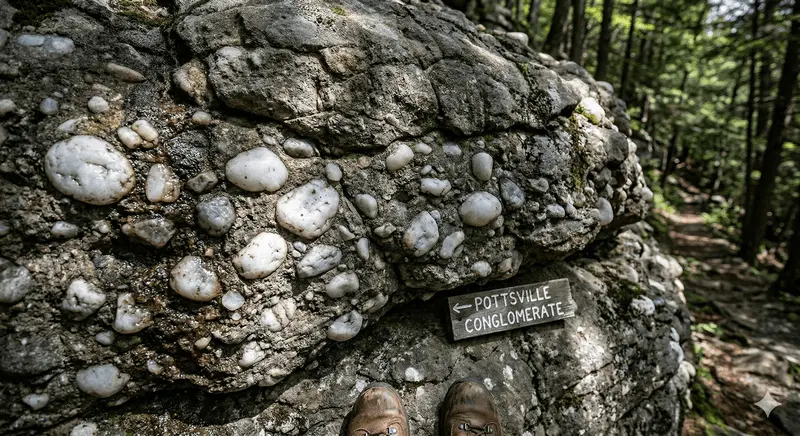
If you hike the trails near Jakes Rocks or Rimrock, you will notice a peculiar type of stone: a hard, greyish-white rock packed with smooth, milky-white pebbles. This is Pottsville Conglomerate. These pebbles were once the bedload of ancient, high-energy rivers that tumbled down from the ancestral mountains. Over millions of years, heat and pressure cemented these river deposits into a rock so durable that it effectively acts as a "capstone" for the entire plateau.
This conglomerate layer is the reason the Kinzua Valley exists in its current form. Because the caprock is so resistant to erosion, the smaller streams were forced to cut narrow, vertical paths through the softer shales beneath it. This created the dramatic "v-shaped" valleys that made bridge-building such a necessity for the coal and timber barons of the 19th century.
The Mystery of the Rock Cities
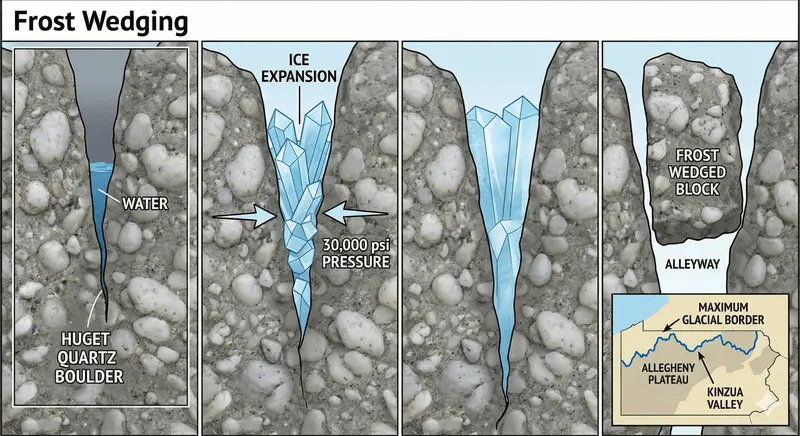
Perhaps the most striking geological feature of our region is the presence of "Rock Cities"—labyrinthine clusters of massive, house-sized boulders separated by narrow "streets." While they look like they were tossed there by giants, their origin is a masterpiece of physics called Frost Wedging.
During the last Ice Age, the great glaciers stopped just a few miles north of the Kinzua Valley. While the ice didn't flatten our hills, the climate was sub-arctic. Water would seep into the vertical joints of the conglomerate caprock, freeze, and expand. With a force of nearly 30,000 pounds per square inch, the ice acted as a hydraulic jack, slowly pushing 500-ton blocks of stone away from the main cliffs.
A Legacy in the Foundations
When Octave Chanute arrived in 1882 to design the original iron viaduct, he wasn't just fighting the wind; he was fighting the geology. The very hardness of the conglomerate that created the gorge made it an ideal, unyielding foundation for the 110 masonry piers that held the towers. However, for the work crews tasked with hand-drilling into this "mountain stone," it was a grueling reminder of the plateau’s ancient, industrial-strength origins.
Today, as we walk the Skywalk, we aren't just looking at a feat of human engineering. We are standing on the literal debris of a mountain range that existed before the first dinosaur ever walked the earth. The Gazette reminds its readers: the next time you pick up a smooth white pebble from a Kinzua streambed, remember—you’re holding a piece of a story 300 million years in the making.