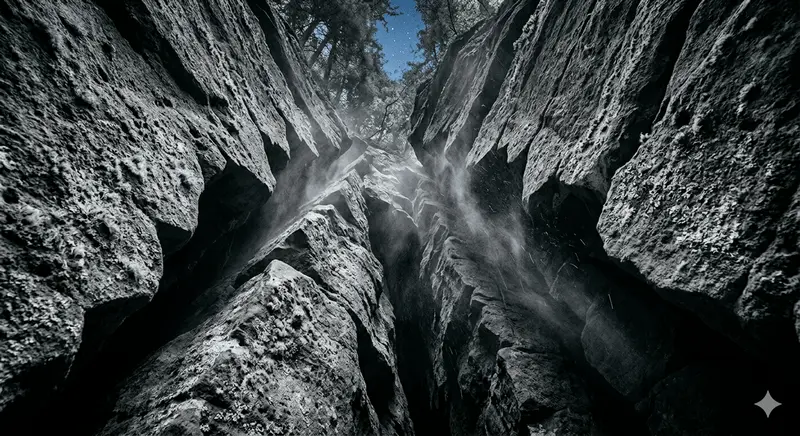
Deep in the unglaciated "Old Plateau" (see Art. 21.1), where the valleys are steep and the sandstone is ancient, lies one of the region's rarest acoustic anomalies. It is known to the locals of Forest County simply as the Wolf Mouth.
It is not a destination you will find on any official Forest Service map. It is a secret guarded by the terrain itself—a series of deep, vertical fissures in the Pottsville Sandstone that produce a sound that has chilled the blood of hunters for over two centuries.
The Anatomy of a Howl
The Wolf Mouth is a natural Aeolian Harp. When the wind whistles off the Allegheny Front and funnels into the narrow V-shaped ravines, it creates a "venturi effect." As the air is forced through the jagged, narrow stone slits of the formation, it vibrates.
-
The Sound: It isn't a whistle or a hum. It is a low, mournful, multi-tonal wail that mimics the exact frequency of an Eastern Wolf’s howl.
-
The Trigger: It only happens when the wind blows from the Northwest at exactly 15–20 mph. On a calm day, the rocks are silent. During a gale, the sound becomes a deafening shriek.
The Legend of the Last Pack
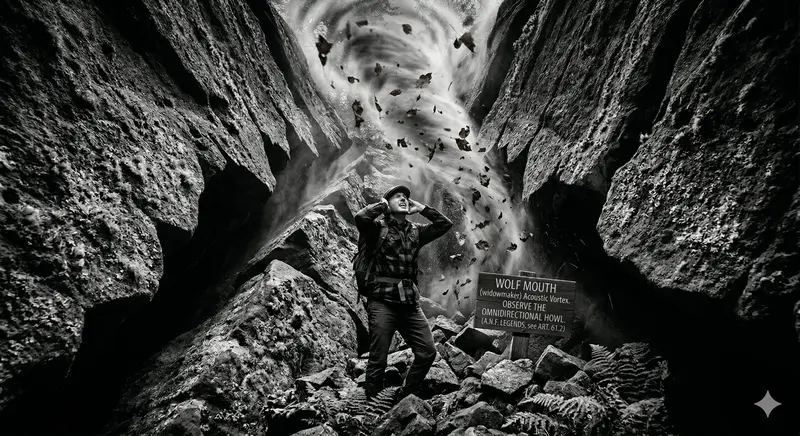
Frontier lore from the 1800s claims the site was the final refuge of the "Black Pack"—the last breeding pair of wolves in the Pennsylvania Wilds. When the final wolf was trapped and killed in 1892, the legend says the very rocks of the plateau "caught" its final cry.
Seneca tradition (see Art. 51.1) suggests a different origin. They speak of the Stone Throwers using the fissures as pipes to communicate between the valleys. To blow a horn into the Wolf Mouth was considered a grave insult to the spirits of the deep earth.
The Search for the "Singing Fissure"
Finding the Wolf Mouth is famously difficult. Because the sound is a low-frequency vibration, it is omnidirectional. You can be standing fifty feet from the rocks and feel the sound in your chest, yet be unable to tell which direction it’s coming from.
Most who claim to have found it describe a "cold spot" in the forest where the ferns stop growing and the rocks are covered in a strange, pale lichen that looks like matted fur.