When the final rays of sun dip below the Rimrock Overlook, and the boaters and hikers retreat from the Kinzua Reservoir, a second, silent ecosystem wakes up. Tracy Ridge, the vast, rugged heart of the Allegheny National Forest, changes guards. The creatures of the day hide, and the undisputed masters of the night shift begin their patrol: the owls.
To follow the owls of Tracy Ridge is not about seeing; it is an exercise in auditory submersion. These apex nocturnal predators are designed for total stealth, using uniquely adapted, fringed feathers that break up air turbulence, allowing them to fly in absolute, terrifying silence. While they are ghosts to the eye, they are vibrant and audible indicators of the forest's health. For those who know how to listen, the darkness of Tracy Ridge is a complex, vocal symphony.
Here is the roster for the Gazette’s guide to the nocturnal shift.
1. The Territorial Haunt: The Great Horned Owl
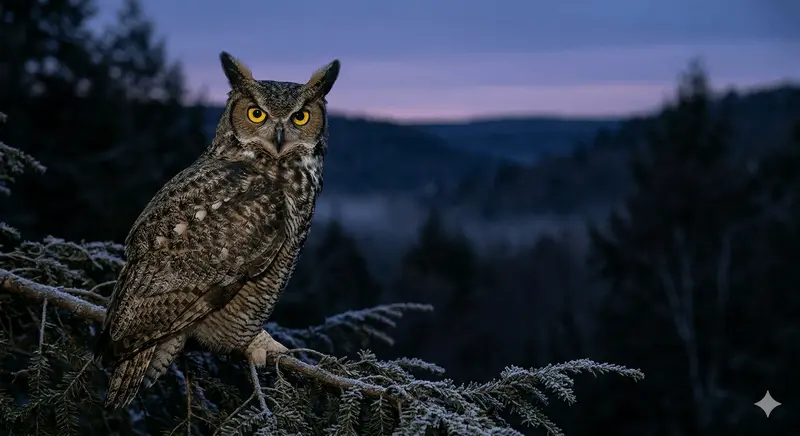
The largest and most formidable owl on the plateau, the Great Horned Owl (Bubo virginianus) is the alpha of the night. Their silhouette, marked by signature feather "horns" (plumicorns), strikes fear into everything from rabbits to skunks—and even other owls. Their call is the quintessential sound of the deep woods: a deep, resonant series of five to seven muffled hoots, often described as Hoo-h'HOO-hoo-Hoo. If you hear this hoot echoing across a Tracy Ridge hollow, you are listening to the sound of established, dangerous authority. They are early nesters, often claiming territory and hooting forcefully while snow still blankets the forest floor.
2. The Sound of the Swamps: The Barred Owl
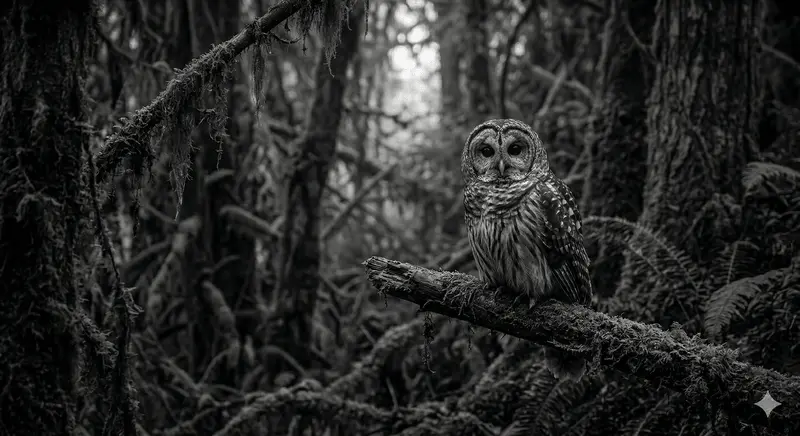
Go to any low-lying, damp area near the reservoir or a creek bottom, and you will hear the Barred Owl (Strix varia). They are often mistaken for Great Horneds, but they lack ear tufts and are defined by dark, soulful eyes (as opposed to the yellow of most other owls). Their call is legendary and unforgettable—a rhythmic, conversational series of eight hoots that sounds exactly like, "Who cooks for you? Who cooks for y'all?" They are highly vocal and inquisitive; one hoot can often trigger a cascading response from Barred Owls across adjacent hills, creating a mesmerizing chorus.
3. The Whinny in the Dark: The Eastern Screech-Owl
The smallest and most versatile on the shift, the Eastern Screech-Owl (Megascops asio) is a master of camouflage. Barely larger than a pint glass, they often hide in plain sight inside tree cavities. Their name is a severe misnomer; they do not screech. Instead, their voice is a haunting, tremolo "whinny," starting low and rising, like a spectral miniature horse in the distance. They also make a separate, descending "monotonic trill." Listen for their unique calls in varied habitats, particularly where older, cavity-filled trees are common.