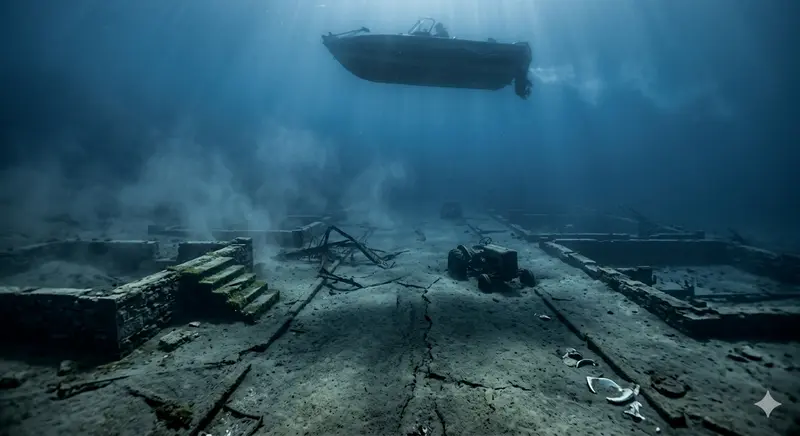
If you boat across the glass-calm waters of the Allegheny Reservoir on a quiet morning, you are floating over a lost world. Sixty feet below your hull lies the main street of Kinzua, the quiet neighborhoods of Corydon, and the vanished whistle-stops of Morrison and Dewdrop.
In 1965, when the Army Corps of Engineers closed the gates of the Kinzua Dam, they didn't just create a lake; they executed a death sentence for a century of history. This is the story of the towns that were sacrificed to tame the river.
The Great Relocation
The construction of the dam was a multi-year operation of clinical efficiency and deep human heartbreak. To prevent debris from clogging the new reservoir, every structure in the valley had to be accounted for:
-
The Clearing: Thousands of acres of ancient timber were clear-cut.
-
The Demolition: Homes, schools, and churches were leveled. Some were moved to higher ground (the "New" Kinzua), but most were reduced to their concrete foundations.
-
The Dead: In perhaps the most somber task, thousands of graves were exhumed from valley cemeteries and re-interred on the high plateaus.
-
The Foundations: On high-resolution sonar, the grid of Corydon is still visible—basement rectangles, stone steps leading nowhere, and the "ghost" of the old railroad bed.
-
The Bridges: The massive stone piers of the old Kinzua bridge still stand underwater, silent sentinels in the dark.
-
The "Hitchhikers": Divers and sonar operators have reported seeing submerged farm equipment and even the remains of old "bark-peeling" camps that were too heavy to move.
A Broken Treaty
For the Seneca Nation, the flooding of the valley was more than just a loss of property; it was a violation of the 1794 Canandaigua Treaty, signed by George Washington himself, which guaranteed their lands "as long as the sun rises."
The dam swallowed nearly 10,000 acres of ancestral Seneca territory, including the longhouse sites and the medicinal plants that grew only in the fertile river bottom. The forced relocation remains a raw wound in the heritage of the Kinzua country.
What Remains Down There?
The reservoir is not an empty bowl. It is a preserved museum of 20th-century life, hidden in the cold, anaerobic depths where wood and stone rot slowly:
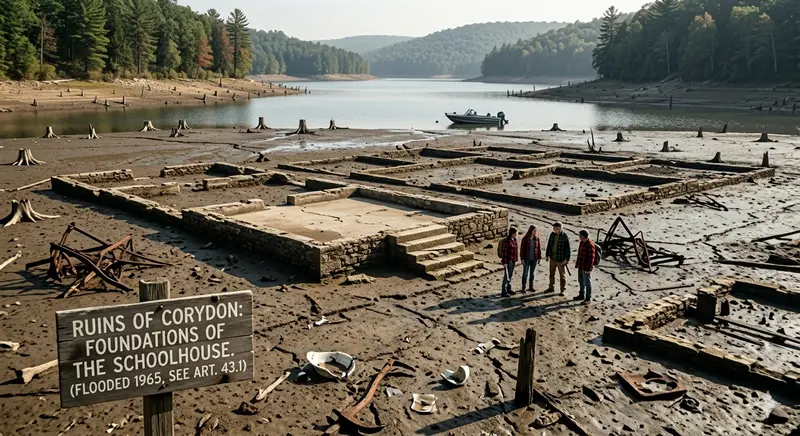
The Seasonal Reveal
During years of extreme drought or planned "draw-downs" for dam maintenance, the Allegheny Reservoir gives up its ghosts. As the water recedes, the mud-slicked foundations of Kinzua emerge like ruins of an ancient civilization. For a few brief weeks, families return to walk the streets where their grandparents once lived, finding rusted nails or pieces of broken china—the only physical evidence of a life "under the glass."